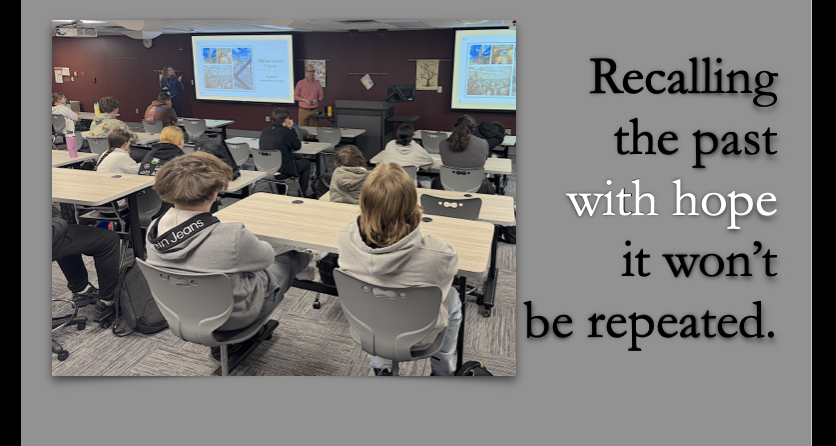
For the fourth time, in as many years, Dave Reckess, grandson of Holocaust survivor Sarah Tuller, made three compelling presentations to Newark High School sophomores February 27th who are taught each year about one of the most horrifying chapters in human history.
To view the designed article, visit: https://aptg.co/CH1dhV
As in the past three years, Reckess, Executive Director of 3GNY Descendants of Holocaust survivors, included photos and videos of his grandmother telling riveting stories to about 160 Global 10 students at NHS.
Justin Fladd, NHS Global Studies 10 teacher, said Reckess’ presentations were “phenomenal.”
He also said he Michael Baronich’s Global 10 students were “very engaged, asked lots of questions that followed Reckess’ talks, including in-depth ones and some students from each of the three presentations stayed after the bell to ask him more questions.”
NHS Principal Kelly A. Zielke was pleased students had the opportunity to hear Reckess.
“I want to thank Mr. Reckess for sharing the story of his family with our students. It is a wonderful experience for our young people to hear about the past from someone who can share so much detail. Thank you again to Mr. Fladd for organizing the event, and to all the students who were respectful and truly represented our school and district well.”
Here’s the essence of the compelling story Reckess shared.
While all four of his Jewish grandparents were sent to concentration camps, all four miraculously survived. So his presentations focused primarily on his maternal grandmother whose maiden name was Sarah Feldzamen. He enduringly refers to her as “Bubi” Sarah, since “Bubi” is Yiddish for grandmother.
Born in 1922 in Lublin, Poland, life for Sarah changed over her childhood years but took a dramatic turn in her teens when harsh restrictions, she thought would only being imposed on Jewish people in Germany, were placed on Jewish citizens in Poland. They had to wear yellow armbands to identify themselves. Demeaning, antisemitic signs went up all over the town. Kids who were once her friends, would throw stones at her. At 16, she could no longer attend school because Jews were not allowed. Strict curfews had to be adhered to. Jewish families, now forced to live in apartment buildings called ghettos had to pay Nazi soldiers money. They had to keep their shops and businesses, that few townspeople would no longer frequent, open so Nazi soldiers could come in and take whatever they wanted to.
At night, Nazi soldiers would order certain segments of Jews in Lublin to immediately leave their apartments and board trucks headed for concentration camps. Many of Sarah’s friends gradually disappeared. Her brother, who tried to evade this fate, attempted to flee to Russia, but was captured, imprisoned and was killed in captivity.
At 19, Jewish men and boys of Lublin were forced to build a concentration camp in nearly Majdanek, which all the remaining Jews in the community were forced to live in once it was completed.
“The Nazis treated us like dogs, actually not even dogs, more like stray dogs. They took away our dignity. They dehumanized us. I knew that even though I was treated terribly, I just had to go on living and that helped me survive,” Tuller shared on a video made several years ago.
Miraculously, not long after they arrived at Majdanek, a Nazi guard told Sarah’s boyfriend, Yehuda, who had come to the camp with his ailing mother, that some people could try to escape at midnight. He said he would open the gate, look the other way and let people escape. But in three minutes, he would release his 7 dogs to chase after them.
Sarah’s boyfriend, who knew he could not leave his sick mother, persuaded her to try to escape with her parents and 17-year-old brother or they would face certain death in the concentration camp. Amazingly, they all made it back to nearby Lublin and stayed for a couple of days with a Catholic family they trusted. After a few days, the Catholic family, in fear for its own safety for harboring the Feldzamen family, told them they had to leave. The Feldzamens soon managed to board a train to Warsaw where a kind, non-Jewish family they knew let them stay in a concealed room in their tiny apartment for 3.5 years. The Feldzamen’s colorless existence was fraught with loneliness, anxiousness, fear, sadness and monotony. But the kindness of their hosts, who placed their own lives in danger, and their hope of a better future someday kept the Jewish family from giving up.
Reckess said his grandmother and family often wondered if perhaps there would be a world worth living in when the war was over.
In the spring of 1945, the Russian Army reached Warsaw and freed it from the Nazis.
Before that, Sarah’s family, because they had no idea of what had happened to so many Jews, wondered if they were the only ones left and how it would be for them when they re-emerged into the world. Once freed, they returned to their home city of Lublin where the family searched for anyone they knew that managed to survive. They found a friend of her older brother named Sasha Tuller who had fled to Russia in the beginning of the war. He was the only member of his family to survive. Sarah and he became close and soon married. And then, along with her parents, they moved to New York City whereas immigrants they created a new life. They had three children and ran a successful fabric shop in Brooklyn and had many good years together.
Sasha Tuller died in 1985. Years later, Sarah met and married Morris Golub, who encouraged her to talk about her experiences and chronicled them into a 70-page history manuscript which Reckess and his family treasure and can be seen in the U.S. Holocaust Memorial Museum in Washington, D.C.. Golub died in 2016. Sarah died three years later at age 97, not long after she had shared her story, for the umpteenth time publicly, this time to some 5th and 6th graders at their school.
Daunting memories of the Holocaust and its impact on her family and so many others she knew and loved, didn’t permanently scar Sarah. She lived a full productive life. Her obituary says it best: “Through it all, Sarah lived her life with abundant energy, honesty and determination. She was spunky, big-hearted, and left an indelible impression on everyone she met. She taught us that life is not always fair. But while we are here and living, we should make the most of it. She showed us how to enjoy life and treat each day as a marvelous gift.”
That’s why Reckess is carrying on her legacy with his work with 3GNY, an educational, non-profit organization founded by grandchildren of Holocaust survivors. On its website, its mission is clearly delineated: “As a living link, we preserve the legacies and the lessons of the Holocaust. Our mission is to educate diverse communities about the perils of intolerance and to provide a supportive forum for the descendants of survivors.
“We feel a deep commitment to know and tell our family stories, and to place them within the greater context of the Holocaust. 3GNY also raises awareness about human rights issues and genocide – past and present.”
“I am truly honored and privileged to bring 3GNY and Dave Reckess back to Newark again,” Fladd said. “The presentation allows my students to understand the atrocities of the Holocaust at a deeper and more personal level. With the rise of antisemitic acts all across the world, the work of 3GNY is more important now than ever."
Jacquelyn Wadsworth, Special Education teacher at NHS who teaches Global 10 said: “Dave's efforts to preserve and pass on his grandmother's memories and experiences offered our students a meaningful connection to history that goes far beyond textbooks. His moving presentation gave them a deeper understanding of the strength, resilience, and humanity behind this difficult chapter in our world’s past.”
Michael Baronich, who teaches Global 10 said: “The respect and attention our 10th graders displayed was amazing. Students related to Bubi Sarah's struggle to want better for herself and her family. Students spent the next few lessons bringing up moments from Bubi Sarah's incredible life. It is so important for students to keep the memories of the Holocaust present as history has a way of repeating itself.
And what did students think about the presentations? Here are some of their thoughts.
Madison Chamberlin: "I enjoyed how raw it was. You can hear thousands of stats about the Holocaust, but it doesn't hit nearly as hard as a real story. I definitely cried and felt a lump in my throat for several hours after the presentation. It helped me put my own life into perspective."
Maggie Cornwell: "I loved how invested and interested he seemed to be in his family's history. It made me feel thankful that things aren't like this today. There's still discrimination but much less. I learned how truly serious the Holocaust was and how people were impacted."
Olivia Parish: "Bubi Sarah showed us that live moves on and that you have to keep living no matter what. As a high school student, that was very inspirational to me."
Haley Frey: "The presentation made me feel grateful for being born in the United States."
Natalie Garland: "I liked the emotion of the story and how she grew from her experiences. I learned not to take life for granted."
Reckess, who has been invited to speak to NHS Global 10 students next year, is happy to return. He said:
“In a time of rising antisemitism and divisiveness, personal stories matter more than ever. When students connect with my grandmother Bubi Sarah’s journey, they don’t just learn history, they begin to understand their own responsibility to recognize hate and stand up against it.”